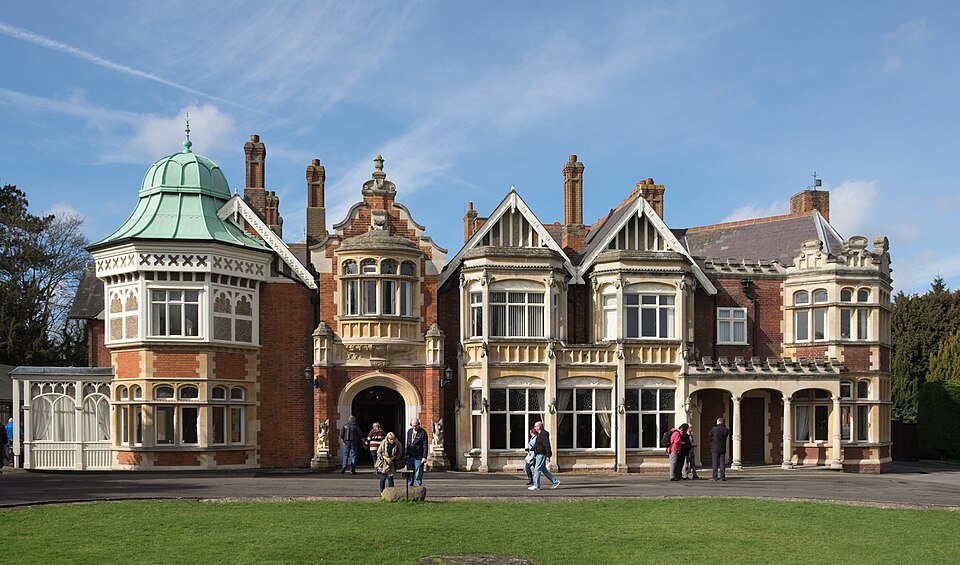
Bletchley Park, a Victorian mansion in Milton Keynes, was the top-secret home of Britain's codebreakers during World War II. In 1939, the Government Code and Cypher School (GC&CS) moved here, assembling a remarkable team of mathematicians, linguists, chess champions, and puzzle enthusiasts. Their mission: to intercept and decipher Axis communications encrypted by machines like the German Enigma and Lorenz.
The most famous figure at Bletchley was Alan Turing, whose work on the Bombe — an electromechanical device that helped crack Enigma — revolutionised codebreaking. Turing's theoretical work also laid the groundwork for modern computing. The codebreakers at Bletchley Park ultimately decrypted over 4,000 enemy messages per day, providing Allied commanders with vital intelligence known as "Ultra." Historians estimate that Bletchley's work shortened the war by two to four years, saving millions of lives.
At its peak, Bletchley Park employed nearly 10,000 people, the majority of whom were women. The 200-strong "Wrens" (Women's Royal Naval Service) operated the Bombe machines around the clock. Despite their immense contribution, all work at Bletchley remained classified for decades after the war. Most staff never told anyone of their role until the mid-1970s. Today, Bletchley Park is a museum and a monument to British ingenuity and the power of intelligence.