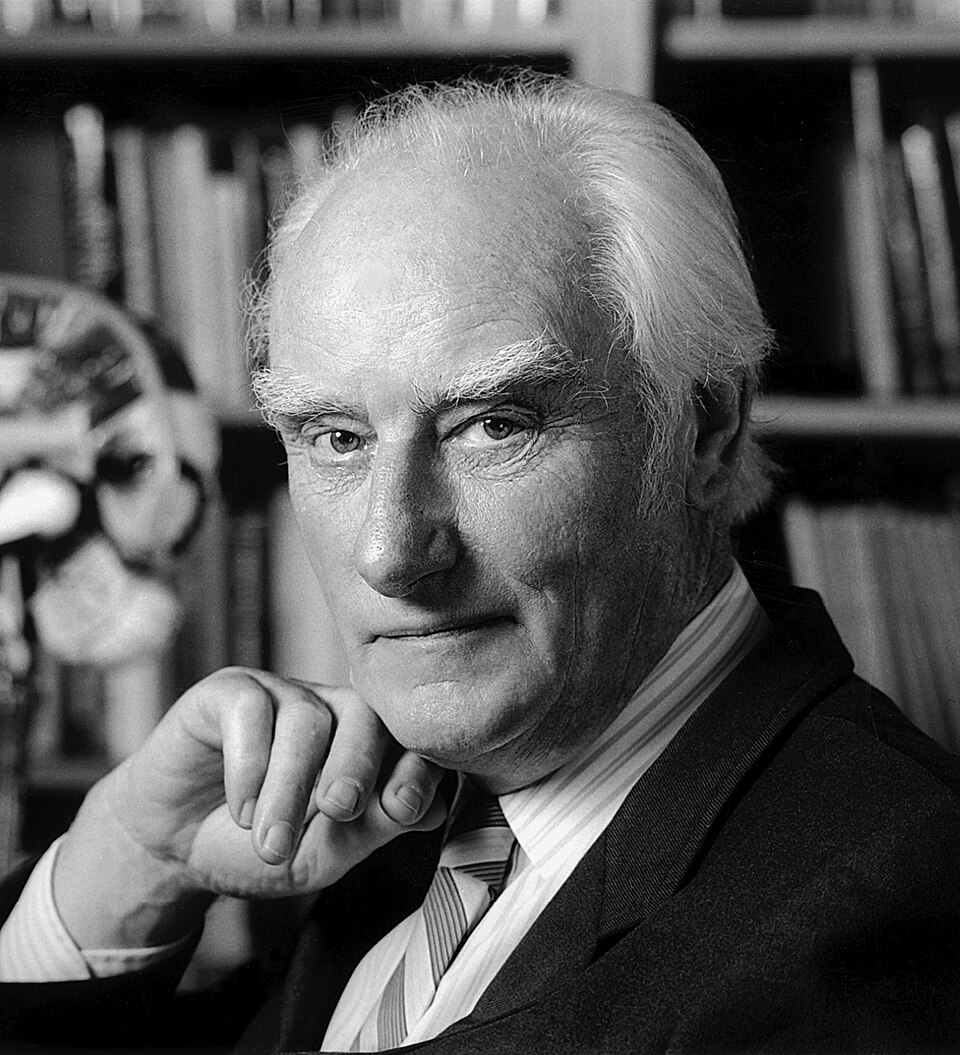
On 28 February 1953, James Watson and Francis Crick first announced their discovery of the double helix structure of DNA to startled lunchtime patrons at the Eagle Pub in Cambridge. Working at the Cavendish Laboratory, the pair had built physical models from metal rods and plates to deduce the structure. Their breakthrough was built on crucial data from other British scientists: Rosalind Franklin's X-ray crystallography images — particularly "Photo 51" — which revealed the helical pattern, and Maurice Wilkins' experiments at King's College London.
Watson and Crick's model, published in Nature on 25 April 1953, revealed that DNA consists of two polynucleotide strands wound around each other in a right-handed helix, with the sugar-phosphate backbones on the outside and the base pairs — adenine (A) with thymine (T), and cytosine (C) with guanine (G) — forming the rungs of the ladder. This structure immediately suggested how genetic information could be stored: the sequence of bases along the DNA strand forms a code. It also showed how DNA could replicate: the two strands separate, and each serves as a template for a new partner strand.
The discovery revolutionised biology and medicine. It earned Watson, Crick, and Wilkins the Nobel Prize in Physiology or Medicine in 1962 (Rosalind Franklin had died in 1958, and the prize is not awarded posthumously). DNA research led to genetic engineering, the Human Genome Project (completed in 2003), DNA fingerprinting (invented by British geneticist Sir Alec Jeffreys in 1984), and revolutionary treatments for genetic disorders. The Cavendish Laboratory in Cambridge, where the discovery was made, remains one of the world's most famous centres for scientific research, and the Eagle Pub still bears a blue plaque commemorating the announcement.