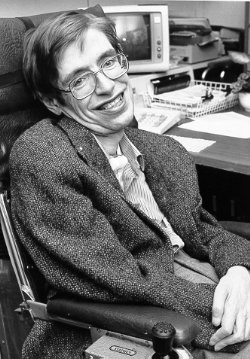
Stephen William Hawking (1942–2018) was one of the most brilliant theoretical physicists since Albert Einstein. Born in Oxford, he studied at University College Oxford and later at Cambridge, where he would spend most of his career. At the age of 21, while studying for his PhD, Hawking was diagnosed with motor neurone disease (ALS) and given just two years to live. Defying all medical expectations, he lived for another 55 years, making groundbreaking contributions to science while gradually losing control of his body.
Hawking's most famous work combined Einstein's general relativity with quantum mechanics to describe black holes. He showed that black holes are not completely black but emit radiation — now called Hawking radiation — and will eventually evaporate. This was revolutionary because it suggested that black holes have a temperature and entropy, linking thermodynamics with gravity. His 1974 paper "Black hole explosions?" became one of the most cited in physics. He also proposed the "no-boundary" theory of the universe with Jim Hartle, suggesting the universe has no edge in spacetime.
In 1988, Hawking published A Brief History of Time, which sold over 10 million copies worldwide and spent 237 weeks on the Sunday Times bestseller list. Despite being unable to speak or move, he communicated through a speech-generating device controlled by his cheek muscle. Hawking was a Lucasian Professor of Mathematics at Cambridge (the chair once held by Isaac Newton), a Fellow of the Royal Society, and received the Presidential Medal of Freedom. His life exemplified the power of the human mind to transcend physical limitations.