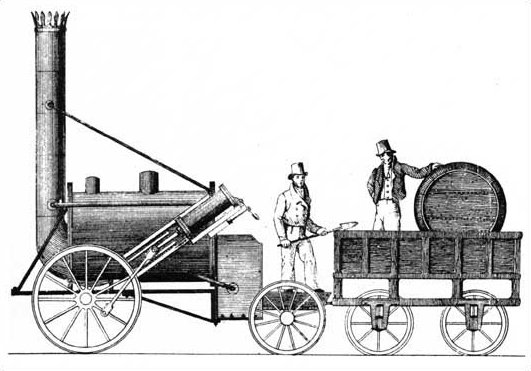
Stephenson's Rocket was a pioneering steam locomotive built in 1829 by George Stephenson and his son Robert at their works in Newcastle upon Tyne. It was designed to compete in the Rainhill Trials, a competition organised by the Liverpool and Manchester Railway to decide which locomotive design would haul trains on the world's first inter-city passenger railway. The Rocket was a revolutionary machine, combining a multi-tube boiler (which greatly increased steam production), a separate firebox, and cylinders set at an angle.
At the Rainhill Trials in October 1829, the Rocket achieved a speed of 24 mph (39 km/h) while pulling a 13-ton load and reached 36 mph (58 km/h) on a light run — far exceeding all other competitors. Its superior boiler design meant it could maintain high steam pressure and sustained speed, making it the clear winner. The Liverpool and Manchester Railway opened the following year, marking the beginning of the railway age. Within decades, railways transformed travel, trade, and industry across Britain and the world.
The Rocket's success established Stephenson's standard gauge of 4 feet 8.5 inches (1,435 mm), which remains the world standard for railways. The original Rocket is preserved at the Science Museum in London, though its appearance today reflects later modifications. The Rainhill Trials demonstrated that steam locomotion was not just viable but superior to horse-drawn or stationary-engine systems, triggering a global railway boom that connected cities, enabled mass transit, and reshaped the modern world.